01 / Question & finding
Clean accuracy does not tell us how the model behaves under a perturbation designed to fool it.
The project starts from a 99% accurate MNIST CNN and asks a simple question. Can an almost invisible pixel perturbation change its decision? And can adversarial training reduce that risk without hurting normal accuracy? An adversarial example is deliberately modified to trigger a model error while remaining visually close to the original input.
Clean accuracy: the starting model is already highly accurate.
Robust accuracy drops under attack, showing why clean accuracy alone is incomplete.
Adversarial training recovers 0.90 percentage point while clean accuracy remains 99.13%.
Main finding: the defense helps in this protocol, but the absolute gain is modest. Attack success falls from 2.07% to 1.29% at ε=8/255, a 0.78-point drop even though the relative reduction is about 38%.
02 / Setup
A controlled experiment with fixed parameters and saved artifacts.
MNIST
60,000 training images and 10,000 test images.
CNN · 3,274,634 parameters
Two convolution layers, two fully connected layers and dropout.
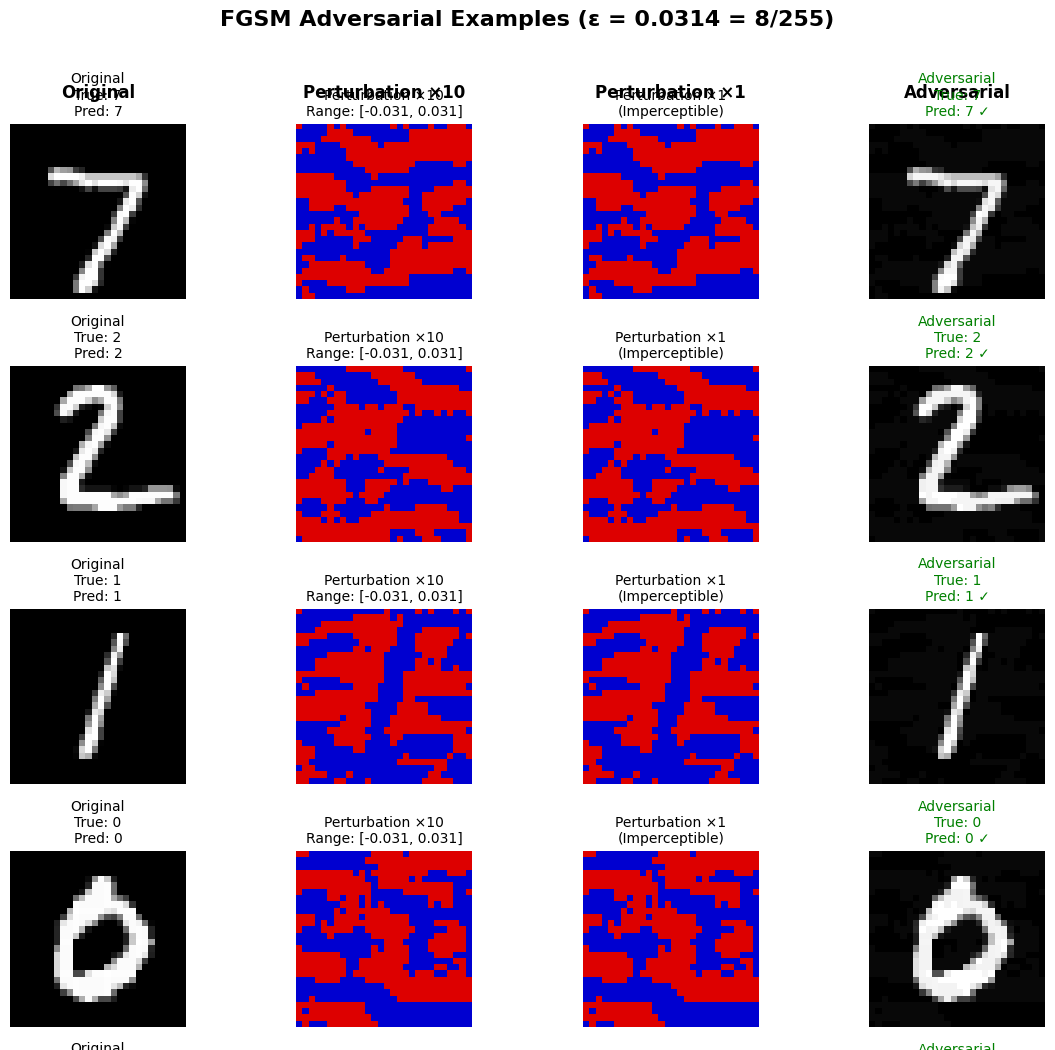
03 / Experiment
The same protocol compares the model before and after defense.
FGSM (Fast Gradient Sign Method) uses the model gradient to modify each pixel within a limit ε. Here ε is 2/255, 4/255 or 8/255: the larger ε becomes, the more freedom the attacker has to perturb the image.
Measure the baseline
Train the CNN for five epochs on clean images and measure normal test accuracy.
Attack it
Generate FGSM examples at the three ε levels and measure how much accuracy drops.
Harden and retest
Retrain for eight epochs with 50% clean and 50% adversarial examples at ε=8/255, then replay the exact same tests.
04 / Results & interpretation
The hardened model is more robust at every tested attack level without sacrificing clean accuracy.
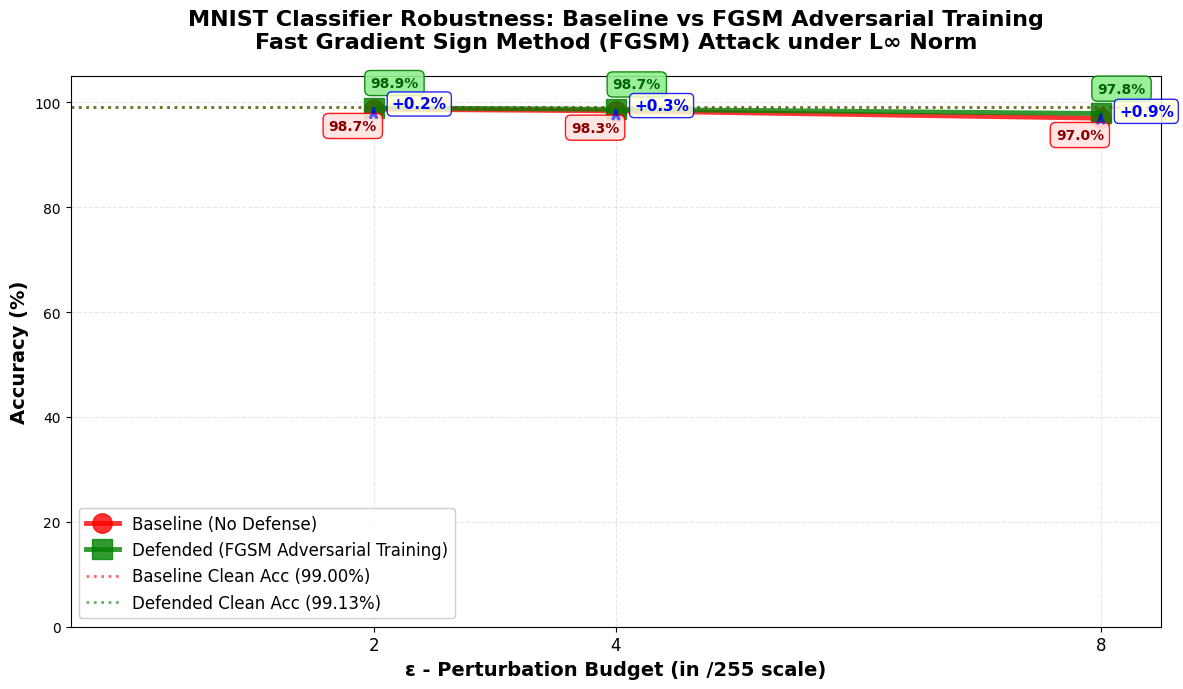
The before-and-after comparison shows a measurable improvement in robustness against FGSM, particularly at ε=8/255, with no drop in clean accuracy in these tests. This complements standard accuracy evaluation; the scope depends on the attack and dataset, as explained in the Limits section.
05 / Reproducibility
Parameters, models, results and plots were saved.
The parameters, models, results and plots used for evaluation were preserved as project artefacts. Checks covered the L∞ bound, gradient availability and visual inspection of the perturbations. The project’s collaborative GitHub repository is linked from this case study.
06 / Limits
FGSM provides an initial robustness baseline; broader evaluation would also examine other attacks and testing conditions.
Stronger iterative attacks such as PGD and broader suites such as AutoAttack are needed before making general robustness claims.
Results do not automatically transfer to complex images or production models.
07 / Conclusion
The experiment demonstrates improved robustness within the FGSM/MNIST protocol tested.
The baseline CNN was already robust on MNIST. Adversarial training improves it further, but the absolute gain remains below one accuracy point under FGSM at ε=8/255.
A robustness claim should always name the attack, its intensity and the trade-off with clean performance. Here the conclusion is useful because it stays bounded: FGSM on MNIST validates an experimental approach, not general robustness against all adversarial attacks.